Virtual water: is it important to Uganda and Kenya?
In my last post, I mentioned the virtual water exports of tea from Uganda and Kenya to the UK as a postcolonial mindset. Virtual water, also known as 'embedded' water (Allen, 1998), is the water used for the production of the commodity in the original place. Countries with higher virtual water imports than exports possess greater water security, and vice versa (Hoekstra & Sung, 2005). As nations heavily dependent on agricultural exports for economic development, this could threaten the water security of Uganda and Kenya in the long run.

Global virtual water trade. Source: Hoekstra et al., 2002.
In Kenya, there is a small net virtual water export (0.1km3/yr) - mainly comprising cut flowers, tea, coffee and other vegetables (Mekonnen & Hoestra, 2014). Groundwater and surface water levels are dropping in Lake Naivasha basin due to heavy usage for irrigating flower farms (Mekonnen et al., 2012). The agricultural exports (cut flowers, tea, vegetables) out of Kenya have increased in recent years, largely due to greater demand from the UK following Brexit. A similar situation occurs in Uganda, although there is a significantly higher net virtual water export - 86km3/yr (Chapagain & Hoekstra, 2003). Exports to the UK amount to a much smaller total value compared to that of Kenya, but the most popular products except for precious metals are all agricultural produce.
What is concerning is that richer trading partners might impose on Uganda and Kenya some policies that they should follow - in a term known as eco-imperialism (Siebert, 1996). This can be in the form of agritechnology, like genetically modified crops or irrigation systems. Because developed countries have a vested interest to ensure that they benefit from the trading relationship, they often expect developing countries to abide by what they want (Nygren, 2014).
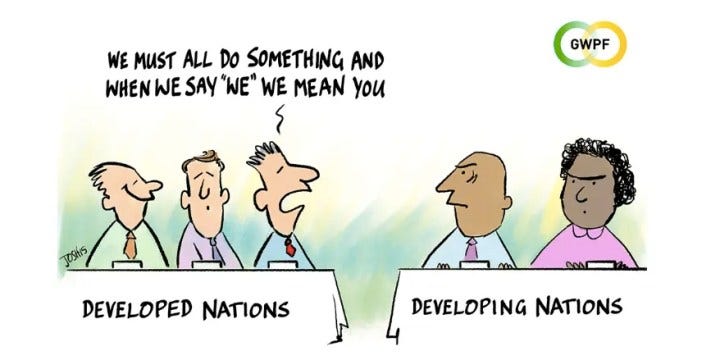
The concept of eco-imperialism in a simple cartoon. Source: Heins, 2023.
If both countries continue exporting large volumes of agricultural products to developed countries at a price that do not reflect the cost of local water usage, then water security will be a significant issue in the future (Gawel & Bernsen, 2011). Both Kenya and Uganda are already considered economcially water-scarce countries (UNDESA, 2005), meaning access to safe water is low. Even groundwater has become an unreliable source of water because of the low rates of recharge in the region. Accessibility to safe water for the average Ugandan or Kenyan remains low despite gradual improvements (UNICEF, 2023).
Virtual water is a by-product of the global economy, and it is not inherently evil. If used effectively, it can alleviate water scarcity in water-poor countries. But developing countries, which tend to be more reliant on the primary sector of the economy, are also the very ones susceptible to the impacts of climate change (Chinowsky et al., 2011). The Ugandan and Kenyan governments should ensure that the cost of water for agricultural exports, especially if irrigation was used, should be factored into the cost of the exports. This will ensure environmental justice for the locals. I turn next to an issue important to all farmers in the region - the decline of bee populations due to climate change.
References
Chinowsky, P., Hayles, C., Schweikert, A., Strzepek, N., Strzepek, K., & Schlosser, C. A. (2011). Climate change: comparative impact on developing and developed countries. The Engineering Project Organization Journal, 1(1), 67–80.
Gawel, E. & Bernsen, K. (2011). What is wrong with virtual water trading?, UFZ Discussion Paper, No. 1/2011, Helmholtz-Zentrum für Umweltforschung (UFZ), Leipzig.
Homewood, P. (2023). Brendan O’Neill: COP28 and the scourge of eco-imperialism. Available at: https://stephenheins.substack.com/p/brendan-oneill-cop28-and-the-scourge?utm_source=profile&utm_medium=reader2 (Accessed 18 Dec 2023).
Nygren, A. (2014). Chapter 5: Eco-imperialism and environmental justice, In Lockie, S., Sonnenfeld, D. A., & Fisher, D. R. (eds), Routledge International Handbook of Social and Environmental Change. Routledge: New York, pp. 58-69.
OEC (2023). United Kingdom/Kenya. Available at: https://oec.world/en/profile/bilateral-country/gbr/partner/ken (Accessed 4 Nov 2023).
OEC (2023). United Kingdom/Uganda. Available at: https://oec.world/en/profile/bilateral-country/gbr/partner/uga (Accessed 4 Nov 2023).
Siebert, H. (1996). Trade policy and environmental protection. Kiel Working Paper, No. 730, Kiel Institute of World Economics (IfW), Kiel.
Taylor, R. G., Todd, M. C., Kongola, L., Maurice, L., Nahozya, E., Sanga, H., & Macdonald, A. M. (2012). Evidence of the dependence of groundwater resources on extreme rainfall in East Africa. Nature Climate Change 2012 3:4, 3(4), 374–378.
The Earth Journal (2021). What is the trade in virtual water? Available at: https://www.youtube.com/watch?v=mYDgnaPZO8I (Accessed 4 Nov 2023).
UNDESA (2005). International decade for action ‘water for life’ 2005-2015: Water scarcity. Available at: https://www.un.org/waterforlifedecade/scarcity.shtml (Accessed 4 Nov 2023).
UNICEF (2023). Drinking water. Available at: https://data.unicef.org/topic/water-and-sanitation/drinking-water/ (Accessed 4 Nov 2023).

How funny I just commented about virtual water on your previous post before reading this one! Another great post, it's been really coherent so far. I think your post raises interesting questions about equitable water pricing. Whilst it's a very big question do you have any thoughts on how fair pricing for water can actually be achieved?
ReplyDeleteHi Manny, that's a great question! I think equitable water pricing is really hard to achieve, no matter where it is applied. On the national scale, the government would have to take up active steps and be willing to absorb costs to ensure that all their citizens can afford water equitably. Yet, when it comes to the international context, there really isn't much enforcement power from international regulatory organisations. The global capitalistic market is built on the basis of efficiency and low-costs, so if one country increases their products citing water costs, then the importing country (e.g. UK) can simply change the country they import from. So unfortunately I don't think there is an extremely viable solution for this on the global scale, as the world is too interconnected.
DeleteBut for certain products, such as rare gems, expensive clothes, advanced tech items, there might be a possibility for the governments of the countries of which these products were produced to charge a water tax. As many of these industries are known to be extremely polluting and water-intensive, so they should be taxed accordingly. Furthermore, the end consumers are often extremely rich people who can afford the marginal increase in price anyway.